
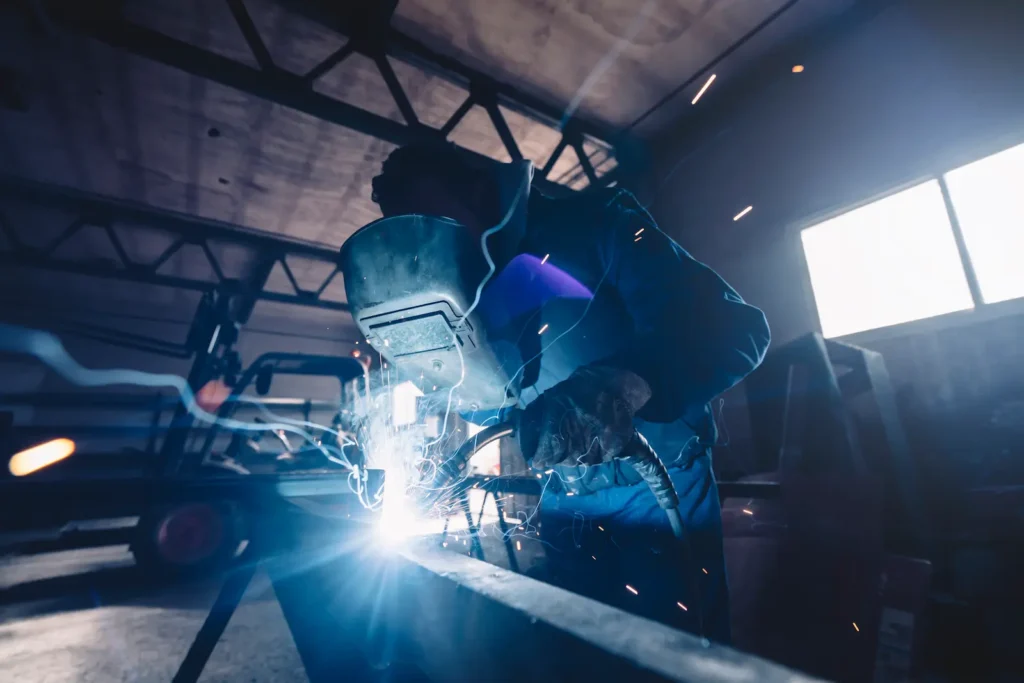
Welding fumes are invisible, odorless, and silently dangerous. The right extraction system isn’t a compliance checkbox, it’s a commitment to the people powering your production floor.
THE HIDDEN THREAT
What’s Really in That Welding Smoke?
Every weld bead laid down releases a cocktail of airborne particles, metal oxides, toxic gases, and ultrafine vapors that linger long after the arc goes cold. Whether you’re working with mild steel, stainless, or aluminium, the chemistry of the fume changes, but the risk stays constant.
What makes welding fumes particularly insidious is that the particles most harmful to lung tissue are also the most invisible to the naked eye. Workers often can’t see what they’re breathing and that’s exactly when chronic exposure begins.
| “Prolonged exposure to welding fumes has been classified as a Group 1 carcinogen by the IARC the same category as asbestos and tobacco smoke.” |
FOUR REASONS THAT MATTER
Why Extraction Isn’t Optional Anymore
| Worker Health ProtectionMetal oxide particles and toxic gases cause respiratory disease, neurological damage, and long-term lung conditions with repeated exposure. | Equipment PerformanceFume deposits on welding equipment and CNC machines degrade precision and trigger costly unplanned downtime. |
| Fire and Explosion RiskCertain metal dusts and vapors are combustible. Allowing them to accumulate is a fire hazard hiding in plain sight. | Legal ComplianceRegulatory bodies across Europe, North America and Asia have tightened OEL limits. Non-compliance means penalties and liability. |
THE PRODUCTION ANGLE
Clean Air = Consistent Welds
There’s a direct line between air quality and weld quality that’s rarely talked about. When fumes and particulates settle on joint surfaces, wire feeders, or optics, they introduce variability, inconsistent fusion, porosity, and contamination that requires rework.
NAF extraction systems are engineered to capture emissions at the source, before they migrate across the workspace. The result isn’t just a healthier environment, it’s a more stable, repeatable welding process with fewer rejects and less rework.
| ↓ 40%Reduction in equipment maintenance when fume load is controlled at source | ↑ 90%Capture efficiency with localised extraction vs. ambient ventilation alone |
WHAT NAF BRINGS
Extraction That’s Built Around Your Process
Not all welding environments are the same a shipyard robotic cell has entirely different airflow and fume volume than a manual MIG station in a fabrication shop. NAF designs extraction systems that fit the process, not the other way around.
From arm-mounted source capture to centralised filter units serving multiple bays, the system configuration is matched to your materials, throughput, and floor layout.
- Source capture eliminates fumes before they disperse into breathing zones far more effective than room ventilation alone.
- Filtration rated for fine metal particles, including chromium VI and manganese compounds from stainless and alloyed steel.
- Modular configurations scale with your facility add extraction points as production expands without replacing the base system.
- Compliance documentation support to meet workplace air quality standards and demonstrate due diligence to regulators.
THE BOTTOM LINE
Safety and Productivity Are Not a Trade-Off
The outdated view is that safety investments slow production. The reality is the opposite when workers aren’t exposed to harmful fumes, absenteeism drops, quality improves, and equipment lasts longer.
Investing in NAF extraction is not a cost of compliance. It’s the cost of doing good work, with the people who make it possible.
| Ready to assess your current extraction setup?Talk to an NAF specialist about a free site assessment and system recommendation. |