Downdraft Extraction Tables for Grinding and Welding
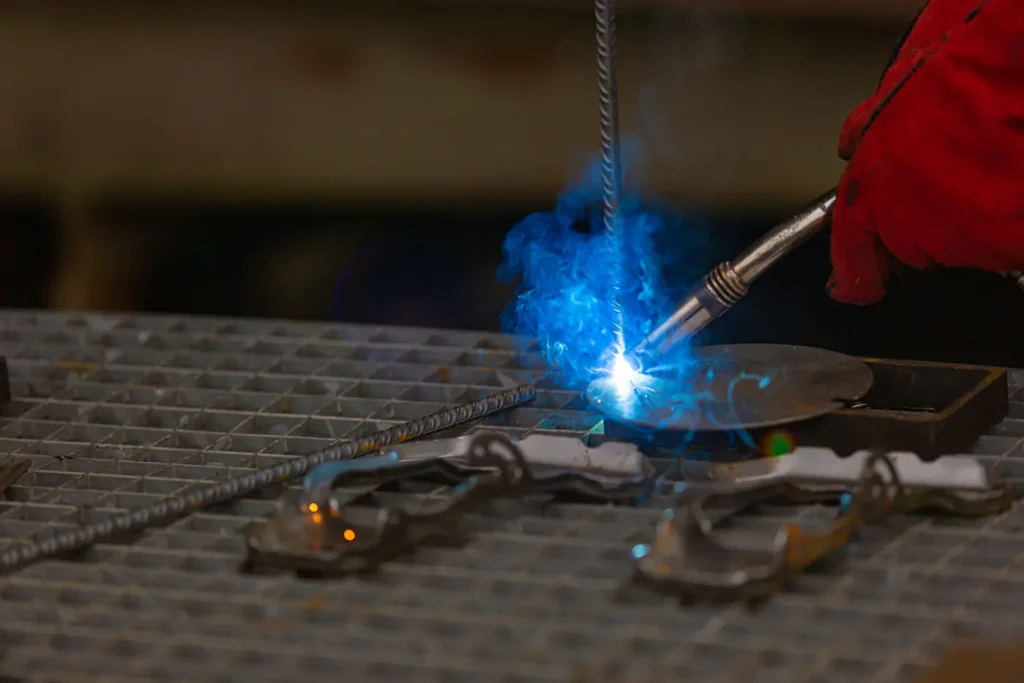
Grinding, deburring and welding have one thing in common. The dust or fume is produced a short distance from the operator’s face, and it starts to spread the moment it leaves the workpiece. A roof exhaust or a hood mounted above the bench will catch some of it, but only after it has risen through the operator’s breathing zone.
A downdraft extraction table works the other way round. It pulls air down through the work surface, so dust and fume are drawn away from the operator at the point where they are produced. This post explains how the table works, what each part does, and where it fits on a shop-floor.
How a downdraft extraction table works
The table top is an open work surface with a fan behind it. When the fan runs, air is drawn downward through the table top, capturing dust, chips, vapour and fumes at workpiece level. Instead of rising toward the operator, the contaminant travels down with the air.
From there, the air goes one of two ways, depending on how the table is specified.
- Connected to a filter unit. The table is the capture point. Air is ducted from the table to a separate dust collector or fume collector, where the filter holds back the particles.
- With an inbuilt dust collector. The filter sits inside the table. Air is filtered within the unit and returned clean to the room, so there is no duct run to an outside collector.
An inbuilt unit suits a standalone workstation, or a location where running ducts is not practical. A connected table suits a line of several tables feeding one collector. If you are weighing up the two, our post on central or standalone extraction covers the trade-offs in more detail.
The parts that do the work
Each part of the table has a specific job in keeping the contaminant moving away from the operator.
- Segment monitoring. Sensors switch extraction on only at the segment in use. Suction is concentrated where the work is happening, instead of being spread across sections of the table that are standing idle.
- Rear wall hoods and lateral air guide panels. These are standard on NAF tables. They add capture surfaces behind and beside the work and guide the air toward the table top, which helps with welding fume, since hot fume tends to rise rather than fall.
- Height adjustment. The table can be set to suit the operator and the job, so the work stays at the level where extraction is effective and the operator is not bending over it.
- Accessories. A bench vise, rotary table, lighting, and a torch and tool holder can be fitted, so the operator works on the extraction surface rather than moving the job to a non-extraction bench.
Choosing the right work surface
The surface is matched to the process, because the material coming off the workpiece is different for each one.
- Grid grate. For coarse grinding and deburring, where chips and heavier particles fall through the grate.
- Wood. For gentle finishing, where the part needs protection from scratching.
- Plasma-cut surface. For cutting processes.
- Anti-static plastic. For electronics assembly and soldering, where static discharge can damage components.
Beyond these, the table handles polishing, blowing out, dosing, cleaning and general mechanical processing.
Sizing and layout
NAF tables start at 750 mm wide and expand in 750 mm segments, so the length is set by the work rather than by a fixed catalogue size. Tables can be set up as individual workstations, connected in series along a line, or arranged as work islands where several operators share one extraction system. For heavy parts, a static load capacity of up to 3,000 kg is available.
Combustible dust needs a different configuration
Some grinding dust can burn. Fine aluminium and magnesium particles, suspended in air in a confined space, can ignite if they meet a spark or a hot surface. A standard extraction table is not built for this risk.
For these materials, NAF offers explosion-protected configurations of the extraction table. If your shop grinds aluminium, magnesium or any other metal that produces combustible dust, tell us the material at the enquiry stage. It changes how the table and the filter are specified, and it is far easier to build in from the start than to add later.
Where an extraction table fits
An extraction table is the right choice when the work is bench-scale and the operator stands at the bench, such as grinding and deburring small parts, welding small assemblies, soldering, and polishing. In these jobs the source of the dust or fume is close to the table surface, which is where the table captures best.
It is not the right choice for parts too large to sit on the table, or for processes that are already enclosed, such as large cutting machines with their own extraction. In those cases a fume collector or dust collector connected at the machine is the better route. We would rather tell you that at the survey than sell you a table that does not suit the job.
Built under licence, made in India
NAF extraction tables are built under licence from ULMATEC GmbH, Germany, and manufactured in India. The design comes from ULMATEC’s engineering. Manufacturing, installation and after-sales support are handled by NAF’s team in Chennai.
Book a free site survey
The right table depends on your process, the material you work with, your part sizes and your shop-floor layout. A NAF engineer can look at all four on site and recommend a configuration, or tell you if a different type of extraction would suit you better.
The site survey is free anywhere in India, and we reply to every enquiry within one working day. Call +91 63745 22593 or write to info@naf.co.in to book one