
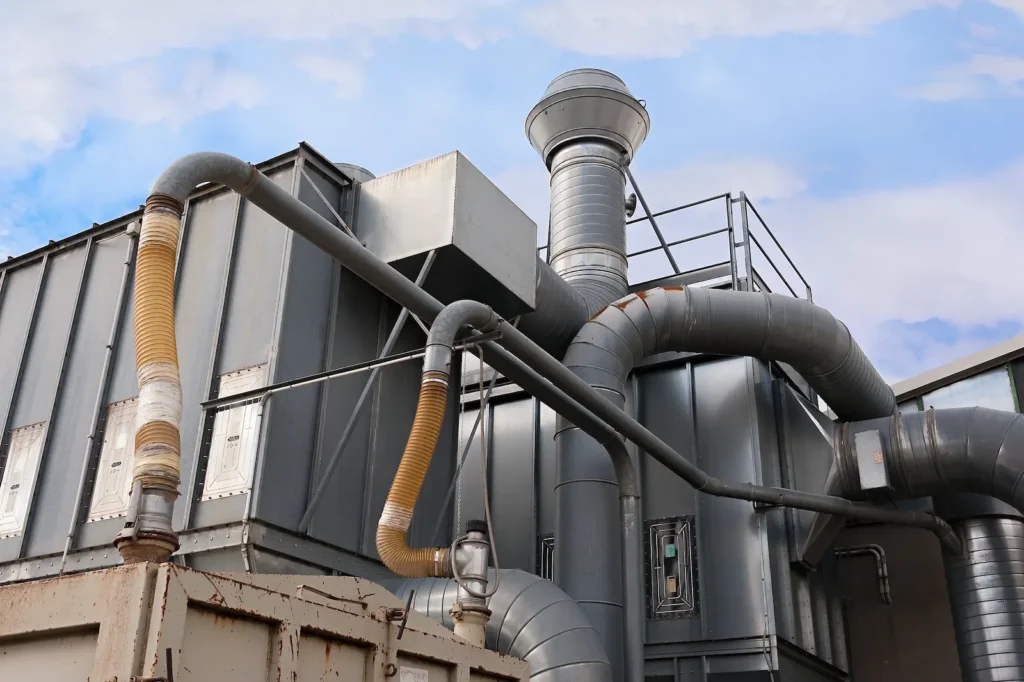
On an automotive line, aluminium dust rarely looks dangerous. It comes off the fettling bench, the polishing wheel and the deburring cell as a fine grey film. Most extraction plans treat it like any other dry dust. For aluminium, that is not enough.
What happened at Kunshan
On 2 August 2014, an explosion at Zhongrong Metal Products, an automotive parts plant in Kunshan, China, that polished aluminium alloy parts, killed 146 people. The published investigation traced the start to the collection barrel below one of the plant’s bag filters, where aluminium alloy dust had ignited on its own. The flame travelled back through the ducts into the building and set off explosions in seven more filter units.
Where the dust comes from
If your plant casts, machines or finishes aluminium, the dust that matters comes from fettling and grinding castings, polishing and buffing, and dry deburring or sanding. Coarse chips are not the main concern. The fine fraction is. The smaller the particle, the less energy it takes to ignite it. Magnesium and titanium dust carry the same risk.
How an ordinary collector becomes the ignition point
- The fuel builds up. Dust collects on the filter and in the hopper. Each cleaning pulse throws a cloud of it into the housing.
- Something ignites it. A grinding spark carried down the duct, a static discharge, or the dust itself. Damp or oily aluminium fines can heat up slowly in a bin until they ignite.
- The ducts carry it back. A fire that starts in the collector can travel through the ducts to every workstation it serves.
A standard dust collector is not built to manage any of this. A collector for aluminium has to be.
Route one, an explosion-protected dry collector
A dry collector can handle aluminium when it is built for it. That means earthed filter cartridges to stop static building up, a spark arrestor ahead of the filter, pressure relief to vent an explosion safely, and components rated for the explosive dust zone. ULMATEC, NAF’s German technology partner, describes a dry collector built this way as the safer choice in many cases.
Where it sits matters too. The Aluminum Association recommends placing dry collectors for aluminium fines outside the building, so that if something does go wrong in the housing, the pressure and flame are released away from people. Housekeeping still applies. Dust on ducts, beams and ledges outside the collector is fuel as well.
The NAF Dust Collector is available in explosion-protected configurations for aluminium, magnesium and other combustible dusts. See the dust collector range.
Route two, a wet separator
A wet separator draws the air through water. Each particle is wetted and bound in the water on contact, and settles as sludge that is removed while the machine runs. No dry dust builds up anywhere in the unit. That makes it a strong option when the dust is also oily, sticky or damp, which would block a dry filter.
Water brings its own rule. Aluminium reacts slowly with water and gives off hydrogen. The Aluminum Association’s guidance is to run the fan for a few minutes before the process starts and for at least two hours after it stops, and to remove sludge at least once a day. ULMATEC advises using wet separation on reactive metals only after careful checking.
The NAF Wet Separator is built under licence from ULMATEC and manufactured in India, in explosion-protected versions for dust zones. See the wet separator.
Which route fits your plant
There is no single answer. The dust decides, and so does how your plant runs. Work through these five questions with your supplier.
- Has the dust been tested? A laboratory test shows how easily it ignites and how violently it burns.
- Is it clean and dry, or oily and damp? Dry dust suits an explosion-protected dry collector. Oily or damp dust points towards wet separation.
- What zone is the collector in? The area needs a hazardous area classification, and every electrical part must be rated for it.
- Are the dust streams kept apart? Aluminium dust mixed with rust or steel grinding dust can react violently. Keep it on its own line.
- Who handles the waste? Collected dust or sludge needs a named owner, a schedule and a safe disposal route before the machine arrives.
NAF supplies both routes, so we have no reason to push one over the other. Tell us the material, the process and your layout, and we will recommend the one that fits. Start with our guide to choosing the right collector, or request a consultation.
Sources
- Li et al., A catastrophic aluminium-alloy dust explosion in China, Journal of Loss Prevention in the Process Industries
- 2014 Kunshan explosion, Wikipedia
- The Aluminum Association, Guidelines for Handling Aluminum Fines
- ULMATEC, Wie lange hält ein Filter in der Pulververarbeitung? (26 September 2026)
- ULMATEC, Wann ist ein Nassabscheider die bessere Wahl? (22 September 2026)
- ULMATEC, Welche Materialdaten braucht ein Hersteller für die Auslegung? (27 August 2026)
- NAF Dust Collectors and Wet Type Dust Collectors product pages