
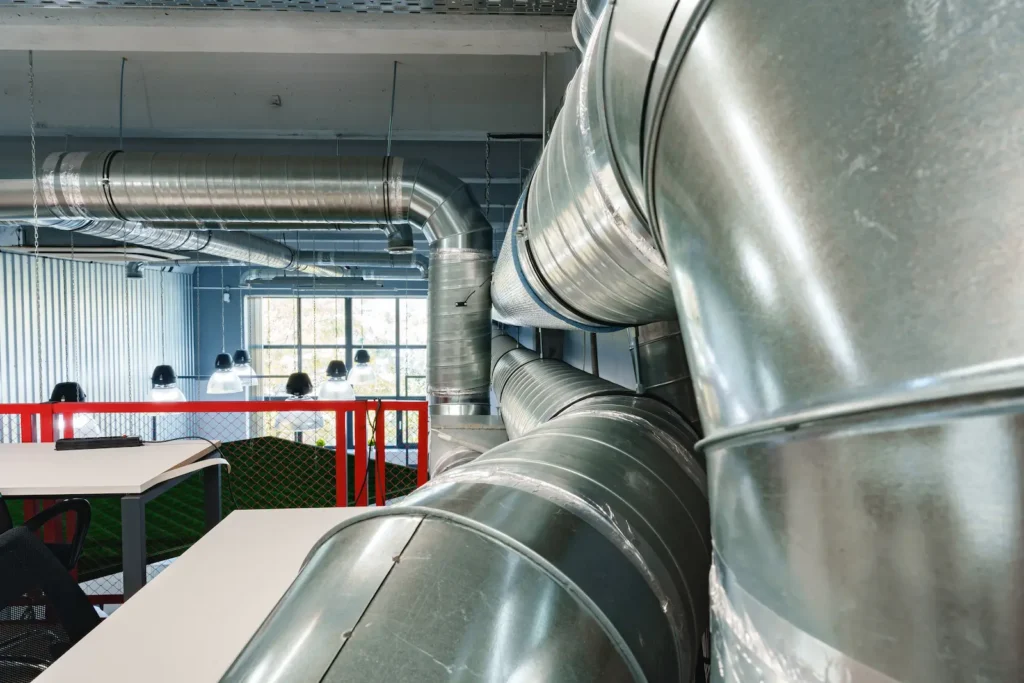
Once a plant decides it needs extraction, the next question comes quickly. Do we build one central system with ducting to every machine, or put a separate unit at each source? The answer depends on how many points you need to extract from, how fixed your layout is, what the contaminants are, and how you expect production to change.
The two options
A central system connects many capture points through one duct network to one filter unit and one fan, or a small number of them. The filter sits in one place, usually outside the production area, and maintenance happens there.
A standalone system puts a self-contained unit at each capture point. Each unit has its own fan and filter. It can be fixed or mobile, and it needs no duct network.
When a central system makes sense
According to ULMATEC, NAF’s German technology partner, a central system usually pays back over separate units once roughly five to ten capture points run at the same time. Beyond that point, the savings add up.
- One place to maintain. Filter changes, inspections and spare parts are handled at a single unit, not spread across the shop.
- One filter strategy. Every connected point gets the same filtration standard.
- Smaller than you might think. Not every capture point is open at once. When the designer measures how many actually run together, ULMATEC puts the possible reduction in system size at up to 40%.
- Room for heat recovery. A central system can be planned together with hall ventilation, so the same air handling does both jobs.
A central system is only as good as its ducting. The air has to move fast enough to keep dust from settling in the pipe, but not so fast that the fan wastes energy and the duct wears out. Every branch has to be balanced so the machine at the far end gets the same suction as the one next to the filter.
Central systems suit plants with a fixed layout and steady processes, such as a welding line, a row of grinding stations or a machining cell that runs every shift.
When standalone units make sense
- The layout keeps changing. Job shops and contract manufacturers who move machines between orders.
- Fixed ducting is not possible. A rented building, or a hall where the roof or floor cannot carry a duct run.
- Only a few points need extraction. Two or three welding bays do not justify a duct network.
- The processes are very different. A welding bay, a CNC machine and a buffing station produce fume, mist and dust. Each needs its own filter.
Standalone units cost less to start with and can be running quickly. The trade-off is that maintenance grows with every unit you add. ULMATEC advises working out both options over the long term before committing.
The contaminant can decide it for you
Some contaminants should never share a duct. Oil mist from machining will coat a dry dust filter and block it. Aluminium dust should be kept away from steel grinding sparks. Welding fume often needs a combination of pre-filter, HEPA and activated carbon that a general dust line does not. When a plant runs several of these processes, the practical answer is often a mix: a central system for the fixed, high-volume line and standalone units for everything else.
Plan for the plant you will have
The layout you have today is not the one you will have in three years. A central system sized only for today’s machines has no spare capacity for tomorrow’s, and a shop full of standalone units becomes a maintenance burden as it grows.
NAF builds its dust collectors from a modular kit of seven modules (exhaust air, fan, filter cleaning, controls, filter, discharge and mobility) in seven size classes, from XS to XXL. The same system can start small and grow with production, without replacing the core unit.
What to bring to the conversation
Whichever way you lean, the design starts with the same information.
- A plant layout drawing, even a hand sketch.
- A list of every capture point, with the process and material at each one.
- Which points run at the same time, and for how many hours.
- Any machines or lines you plan to add in the next two to three years.
With that in hand, talk to NAF. We will work out both options for your floor and show you the cost of each. If you are still deciding what type of collector each process needs, start with our guide to choosing the right collector.
Sources