An aerospace plant rarely has a single dust problem. One site may machine aluminium and titanium, trim and sand carbon fibre panels, strip and re-prime painted parts, and weld or laser cut brackets. Each of these processes produces a different contaminant. A filter chosen for one of them can be the wrong filter for the next, and in some cases a hazard.
This post takes each process in turn, names what it releases, and explains what captures it.
Why dust here is a quality problem.
In most plants, dust is discussed as a health and housekeeping issue. In aerospace it also reaches the part.
- Bonded joints. A small amount of contaminant on a surface that is about to be bonded can interfere with adhesion, according to CompositesWorld. Dust settling in a bonding or layup area is a defect waiting to happen.
- Electrical equipment. Carbon fibre dust conducts electricity. Toray, a carbon fibre manufacturer, advises isolating electrical equipment and machinery from it to prevent damage. Machine controls and panels in a trimming area are exposed.
- Corrosion. Airborne carbon fibre dust can corrode aluminium components nearby, according to the same CompositesWorld article.
So the aim is not only to keep the air breathable. It is to stop dust from leaving the process at all.
Machining aluminium, titanium and magnesium
The chips from a milling or turning centre fall into the machine and are not the main concern. The concern is the fine dust from deburring, grinding, polishing and dry sanding of light metal parts. The smaller the particle, the less energy it takes to ignite it, and magnesium and titanium dust carry the same risk as aluminium.
There are two ways to collect it safely.
- An explosion protected the dry collector. This suits dust that is clean and dry. It needs earthed filter cartridges, a spark arrestor ahead of the filter, pressure relief, and electrical parts rated for the dust zone. NAF builds its Dust Extractor in this configuration.
- A wet separator. The particles are captured in water and removed as sludge while the machine runs, so no dry dust builds up anywhere in the unit. The NAF Wet Separator is built under licence from ULMATEC GmbH in India, in standard sizes from 2,500 to 10,000 m³/h, and is designed for aluminium, magnesium and titanium particles.
Wet separation has its own rules. Aluminium reacts slowly with water and gives off hydrogen, so the fan has to run before the process starts and after it stops, and the sludge has to be removed on a schedule. Our post on aluminium dust, dry or wet sets out how to choose between the two.
Machining centres also release coolant and oil mist, which is a separate stream. A NAF Mist Collector passes the air through five stages of mechanical separation and then a HEPA H13 filter, which captures 99.95% of the remaining aerosols at 0.3 micron. The filters drain themselves, and the collected oil returns to the machine sump or a container. Mist should never be sent to a dry dust filter, because it coats the filter and blocks it.
Trimming, drilling and sanding composites
Carbon and glass fibre composites are trimmed, drilled and sanded after curing. The dust is fine, it carries resin, and in the case of carbon fibre it conducts electricity. Toray lists skin irritation, allergic dermatitis from epoxy resin, and respiratory irritation among the hazards. Treat composite dust as combustible until a laboratory test of your material says otherwise.
Toray’s guidance is direct. “Local removal of dust at the point of generation is highly effective.” In practice there are four ways to capture it, depending on the size of the part and the tool.
- At the tool. A shroud on a router or drill, connected to the extraction line, takes the dust as it is cut.
- At the workstation. An articulated arm, rated from 250 to 3,000 m³/h, sits over the work and is moved with it.
- Through the work surface. A downdraft extraction table pulls air down through the surface while the operator sands by hand. NAF tables start at 750 mm wide, extend in 750 mm segments, carry up to 3,000 kg, and offer an anti-static plastic surface as well as a grid grate.
- Around the part. Panels too large for a table are worked inside a booth, with extraction drawing air away from the operator’s breathing zone. NAF builds modular booths to the dimensions of the part.
The collector behind all of these should have a HEPA after filter for the finest fraction. It should also be placed so that conductive dust cannot reach electrical cabinets if a filter or seal fails.
Paint removal and primer sanding
Many aerospace primers contain hexavalent chromium, a known carcinogen. The US safety regulator, OSHA, lists paint removal, including sanding, grinding and abrasive blasting, among the tasks that expose workers to it. Its exposure limit is 5 micrograms per cubic metre of air, averaged over an 8 hour shift.
OSHA recommends three controls.
- Downdraft or cross-draft booths for parts small enough to move into one.
- Local extraction at the point of work for paint removal in hangars or rooms that only have general ventilation.
- No compressed air to blow dust off aircraft or parts. Blowing simply moves the dust into the room.
For this work the Dust Extractor is specified with a HEPA after filter, and fed from extraction tables, booths or arms at each sanding position.
Welding, laser cutting and plasma cutting
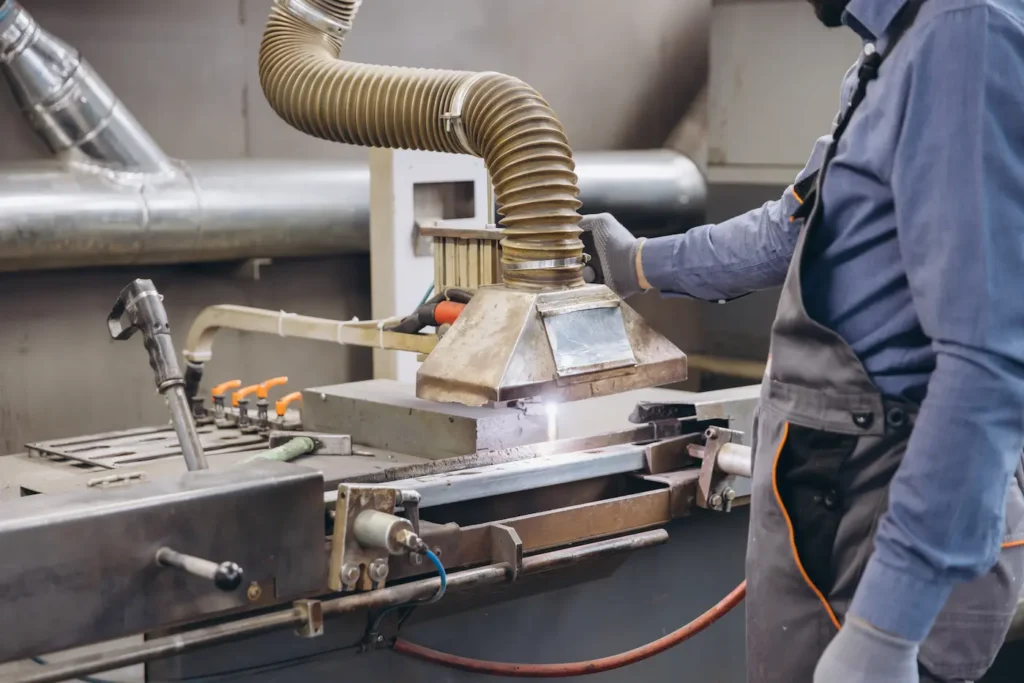
Brackets, frames, ground support equipment and tooling are welded and cut in most aerospace plants. The fume is a fine smoke of metal oxide particles, often with gases. A NAF Fume Collector passes it through a cyclone pre-separator that removes coarse particles and stops sparks, a cartridge filter for the fine smoke, a HEPA after filter certified to H13 or H14, and an activated carbon stage where gases are present. Compressed air pulses clean the cartridges while the unit runs.
Keep the streams apart
An aerospace plant that runs several of these processes is really running several extraction problems at once. The table below sets them side by side.
| Process | What it releases | What to watch | NAF equipment |
| Deburring, grinding, polishing light metals | Fine aluminium, titanium or magnesium dust | Ignition and explosion. Never mix with steel grinding sparks | Wet Separator, or Dust Extractor in explosion protected build |
| CNC machining | Coolant and oil mist | Mist blocks dry filters | Mist Collector |
| Composite trimming and sanding | Fine, conductive fibre and resin dust | Electrical equipment, skin and lungs, bonded surfaces | Extraction tables, arms, booths, Dust Extractor with HEPA |
| Paint removal and primer sanding | Paint dust, which may contain hexavalent chromium | Carcinogen. No compressed air | Booths, extraction tables, Dust Extractor with HEPA |
| Welding and cutting | Metal fume and gases | Fine smoke, sparks | Fume Collector |
Mixing these streams in one duct causes problems. Oil mist blinds a dust filter. Steel sparks can ignite aluminium fines. Conductive carbon dust can travel into areas that should stay clean. In practice most plants end up with a mix, with a central system for a fixed, high volume line and separate units for processes that must stay apart. Our post on central or standalone extraction explains how to decide.
Where NAF has done this work
NAF has supplied a dust extractor to an aerospace plant in Telangana and a wet separator to an aerospace plant in Karnataka. It has also handled composite dust and chromate primer sanding. The equipment is designed and built in Chennai, with design input from NAF’s German partners ULMATEC GmbH and AFS Airfilter Systeme GmbH. See the Aviation and Aerospace section of our industries page for more.
Start with a site survey
Aerospace extraction is specified process by process, so the design starts on your floor, not from a form. A NAF site survey covers the following.
- Every capture point, with the process and material at each one.
- Which points run at the same time, and for how many hours.
- Any laboratory test results for your dust, or the material grades so a test can be arranged.
- Your layout, including where electrical cabinets, bonding areas and clean zones sit.
- Lines or machines you plan to add in the next two to three years.
Book a site survey and we will come back with a configuration for each stream and the reasoning behind it.