
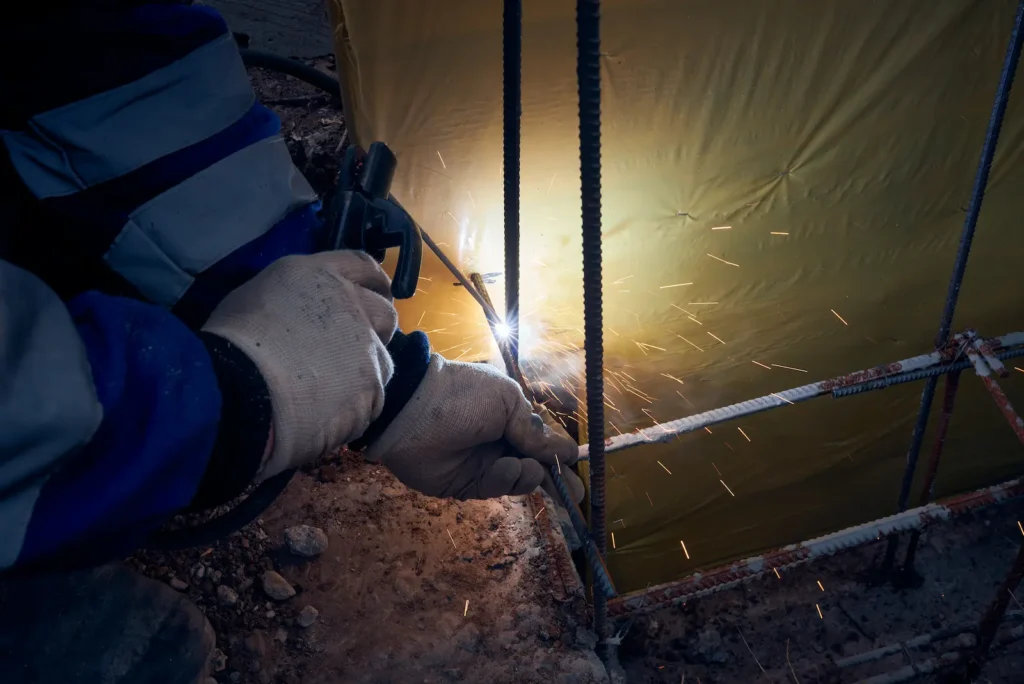
Welding, laser cutting, plasma cutting and soldering all throw off smoke. The part of that smoke that matters most is the part where you can’t see sub-micron metal-oxide particles that don’t settle quickly, drift across the bay, and land on the breathing zone, the machines, and every surface in between. A fume collector’s job is to take that air away at the source, clean it, and give it back.
How the machine works
A fume collector pulls contaminated air from the point where it’s made, moves it through a set of separation stages, and returns clean air to the hall. What decides whether it works is the order and depth of those stages.
The NAF fume collector runs in stages, each handling a different part of the load:
- Pre-separator. Catches coarse particles and stops sparks before they reach the filter media.
- Main cartridge filter. Captures the fine smoke, the bulk of what’s in a welding or cutting plume.
- HEPA after-filter (H13 / H14). Added where the process needs it, this takes capture down to 0.1 micron, into the range where the most harmful particles sit.
- Activated carbon stage. Handles the gaseous components and odour that particle filters don’t touch, for example on coated or oily workpieces.
Cartridges load up over time. NAF uses JetPulse compressed-air cleaning to pulse them clean during operation, which keeps airflow resistance low and extends how long the media lasts before it’s changed. That is the difference between a filter that holds its rated airflow through a shift and one that chokes down by mid-morning.
Your compliance aggregator on the shopfloor
The case for fume collection is usually made on health, and that case is real. But a plant manager feels it first in the process and the machines.
Protects your machine
Fume doesn’t only reach lungs. It settles on laser optics, wire feeders, guides, drives and control electronics. On a laser or plasma line, a film on the optics is drift, and drift is downtime and a service call. Pulling the fume at source is machine protection before it is anything else.
Steadies the cut and the weld
When particulates settle on joint surfaces, feeders or optics, it introduces variability, inconsistent fusion, porosity, contamination, the kind of defect that comes back as rework. Air captured at the source, before it disperses, is one less source of variation in a process you are trying to hold steady.
It keeps the hall clean
Sub-micron fumes that aren’t caught at the source don’t disappear. It coats the hall, and then it’s back on the machines and the floor. You clean more often, and you’re cleaning the same particle twice. Source capture is far more effective here than general hall ventilation, which dilutes fumes but doesn’t remove it from the breathing zone.
Then there is the health case, which is not soft
In 2017 the International Agency for Research on Cancer classified welding fumes as a Group 1 carcinogen, its highest category, meaning there is sufficient evidence that they cause cancer in humans. (IARC Monographs, Volume 118.) The particles most harmful to lung tissue are the same sub-micron particles that are hardest to see. Capturing at source keeps the breathing zone below exposure limits and gives you the documentation to show you’ve done it.
What to ask for?
Start with airflow
The first question is how much air you need to move, and that depends on how many stations you’re capturing and how. NAF builds fume collectors from 100 to 250,000 m³/h across seven size classes (XS to XXL), so the unit is sized to your process rather than picked off a shelf. An undersized unit never holds its capture; an oversized one costs you in energy every hour it runs.
Beyond airflow, four decisions shape the specification:
- Capture method. Arm-mounted extraction at each source, an enclosed cell, or a central unit serving several bays, matched to your layout and how the work moves.
- Filtration depth. Cartridge alone for straightforward welding, or HEPA and activated carbon added where you cut coated material, run oily workpieces, or need to remove gas and odour.
- ATEX build. Where the metal dust or vapour is combustible, the unit needs explosion protection designed in, not bolted on.
- Expandability. A modular unit lets you add capture points as you add machines, without replacing the base system.
The NAF fume collector is built under license from ULMATEC, a German extraction specialist, and manufactured and supported from Chennai. The German design is the engineering behind it; the build, the sizing and the service are local, which is what keeps lead times and cost sensible for an Indian plant.
Specify this to your process
A fume collector earns its place when it’s sized and staged for the work in front of it, the materials, the number of stations, the way the air moves through your hall. Tell NAF your process and we’ll configure the unit, filter, fan and controls, with a full specification and clear pricing.
Talk to NAF: +91 63745 22593 · naf.co.in