Selecting the Right Capture Point – Arms, Hoods, Tables, and Booths
When a plant buys extraction, most of the attention goes to the collector. That makes sense, since it is the biggest item on the quote. But a collector can only clean the air that reaches it. Fume or dust that escapes at the workpiece ends up in the operator’s breathing zone and settles across the shop floor, whatever is installed at the other end of the duct.
What decides how much reaches the collector is the capture point, meaning the arm, hood, table or booth where the extraction starts. This post explains how to choose one.
Why does the capture point matter so much?
Suction weakens quickly as you move away from the opening. An arm placed close to a weld pulls the fume in before it rises past the welder’s face. The same arm left half a metre away captures far less, and turning up the fan does little to fix that.
So the right capture point depends on two things. First, how the contaminant leaves the process, whether as fume that rises, grit and sparks that are thrown, or dust that falls. Second, how much the operator and the workpiece move during the job.
Extraction arms, for fume from one point
An extraction arm is a flexible duct with a capture hood at its tip. The operator positions the hood right at the source, so fumes are drawn in at the point it is made.
NAF’s Articulate Arm is configurable from 250 to 3,000 m³/h. It rotates through 360 degrees and uses gas springs, so it stays where the operator puts it. It is available in different lengths and diameters, and several arms can run off one collector.
Arms suit work done at one spot or within easy reach, such as manual welding at a bench or a small grinding station. Their limit is the operator. If the work moves along a long seam and the arm is not moved with it, capture drops.
Hoods, for processes that throw dust
Some processes throw dust and grit away from the work rather than letting it rise gently. Buffing and grinding wheels are common examples. Here a hood placed in the path of the thrown material catches it more reliably than an arm.
NAF’s N Series wall extraction hoods are adjustable hoods for processes where capture is needed above the work, such as buffing and grinding. NAF’s oval hoods draw dust and mist away at the point of work.
Where the process runs inside an enclosed machine, such as a CNC machining centre, the extraction can connect directly to the machine instead. For coolant mist, that connection usually feeds a mist collector.
Downdraft tables, for work done on a bench
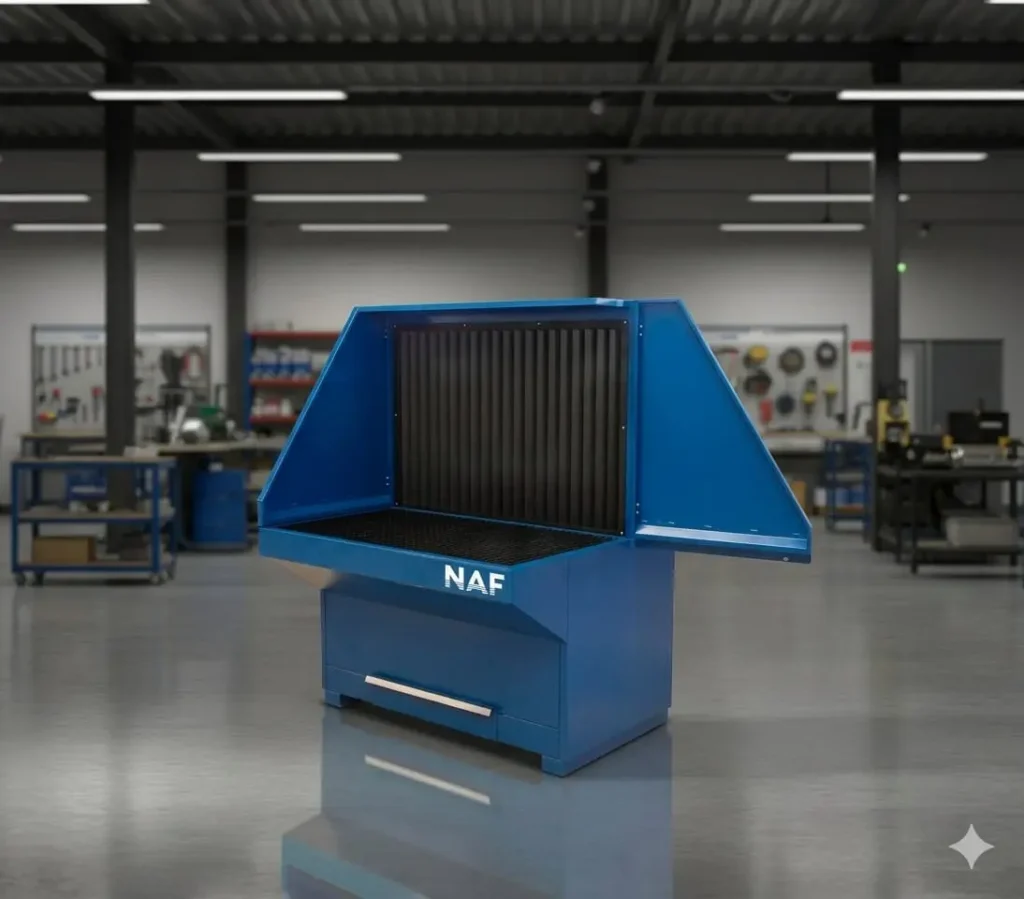
A downdraft table pulls air down through a perforated work surface, so dust and fume travel down and away from the operator’s face rather than up past it. It suits grinding and welding of parts small enough to lay on the table, and it leaves the operator’s hands free. Our post on downdraft extraction tables covers them in detail.
Booths, when one capture point is not enough
When parts are large, the work moves around them, or several operators work in the same area, no single arm or hood can follow the process. A booth encloses the work instead, and the extraction draws from the whole enclosure.
NAF’s welding and grinding booths are modular and sound-insulated, and built to the dimensions the work needs. Besides containing dust, fume and sparks, they shield neighbouring workers from noise and from the glare of welding.
Ducting, which connects it all
Pipes, bends and hoses carry the air from the capture point to the collector, and they affect performance more than most buyers expect. Duct that is too narrow, too long, or has too many bends loses air volume before the air ever reaches the arm or hood.
NAF supplies galvanised iron spiral seam pipe, bends and flexible hoses, sized and laid out for each extraction system. For processes that throw sparks into the duct, such as grinding, spark detection and flame isolation valves can be added. A flame isolation valve closes to stop a fire travelling back through the duct to the collector.
A starting guide by process
The table below is a starting point, not a final answer. The right choice depends on the part size, the layout and how the work is actually done on your floor.
| Process | How the contaminant behaves | Usual capture point |
|---|---|---|
| Manual welding at a fixed bench | Fume rises from one point | Extraction arm or downdraft table |
| Welding large parts or long seams | Fume rises from a moving point | Booth, or an arm the operator repositions |
| Grinding and buffing | Grit and sparks are thrown | Hood in the path of the material, or downdraft table for small parts |
| Machining with coolant | Mist forms inside the machine | Direct machine connection to a mist collector |
| Several operators or robotic cells | Fume and dust across a wide area | Booth |
The right capture point comes from watching the process, not from a catalogue. NAF’s engineers will visit your plant, see how the work is done, and recommend the arms, hoods, tables or booths that fit, along with the collector behind them. Book a site survey at naf.co.in/contact.