A dry dust collector catches dust on filter media and pulses or shakes it off into a bin. For most dry, free-flowing dust, that works well. For some dust, it does not.
Sticky, oily or damp dust smears into the filter instead of releasing from it, and the filter blinds. Fibrous dust mats over the media. Fine metal dust that can burn, such as aluminium, magnesium or titanium, turns a dry filter full of dust into a place where a fire can start.
A wet dust collector, also called a wet separator or wet scrubber, handles these cases differently. It does not filter the dust out of the air. It binds the dust in water.
How does a wet dust collector work?
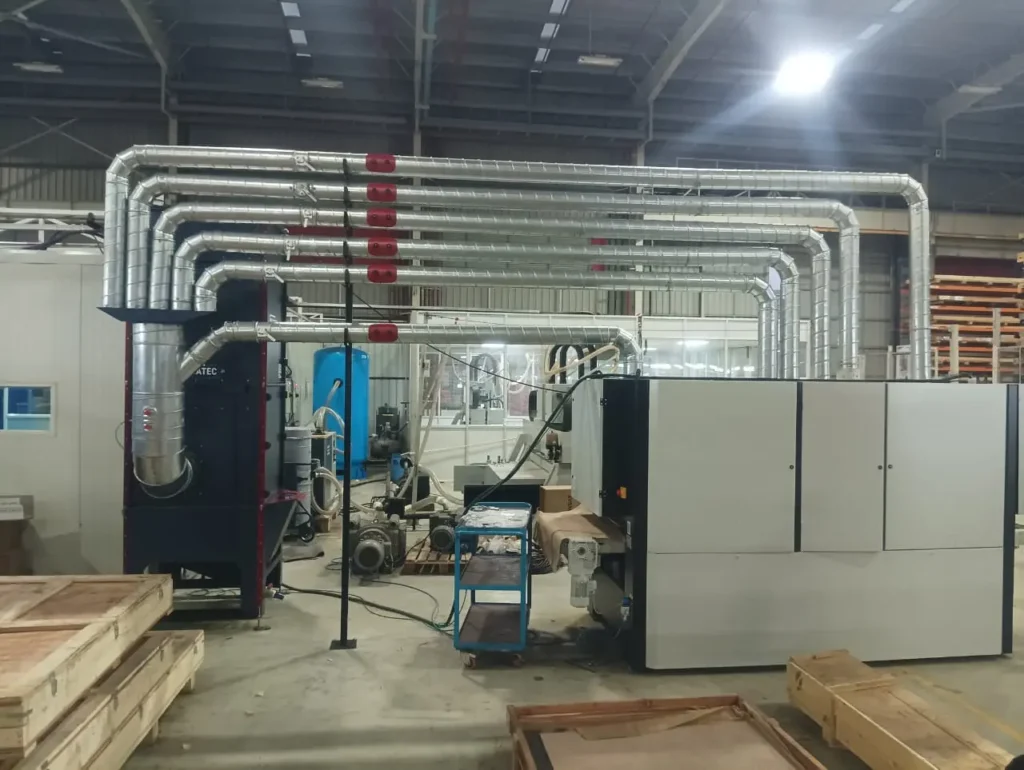
The fan pulls dusty air from the capture point, such as an arm, hood or machine connection, into the unit. Inside, the air is forced through water. Each particle is wetted at the point of contact, becomes heavy, and drops into the water instead of travelling on with the air.
The wetted dust settles as sludge at the bottom of the unit. The cleaned air leaves through an exhaust grid back into the hall, or into a duct to outside. Where the process needs cleaner exhaust air or odour control, a second filter stage can be fitted after the water stage.
In NAF’s Wet Separator, the sludge is discharged and the unit cleaned while it keeps running, so production does not stop for cleaning.
Which dust is a wet collector suited to?
Wet collection makes sense when the dust would clog, burn or react inside a dry filter. That includes the following.
- Dust that can burn or explode, such as aluminium, magnesium and titanium grinding dust
- Sticky, oily or resin-containing dust that would blind a dry filter
- Hygroscopic dust, which absorbs moisture from the air and cakes
- Fibrous dust that mats over filter media
- Moist aerosols, the fine wet mist some processes give off
- Some chemically reactive dust, after a check (see the safety section below)
Typical processes include grinding, deburring, melting, and filling and bagging, in metal, plastics, textile, chemical and recycling plants.
When is a dry collector the better choice?
If your dust is clean and dry, flows freely and does not burn, a dry collector is usually simpler to run. You get dry dust you can bag and dispose of, with no water to top up and no sludge to handle.
Wet collection is not an upgrade on dry collection. It solves a different problem. In some plants the answer is both, with a wet unit added as an extra stage alongside existing dry filters. For aluminium specifically, our post on choosing a dry or wet aluminium dust collector walks through the decision.
What does the NAF Wet Separator offer?
NAF builds its Wet Separator in India under licence from ULMATEC GmbH, with grade 304 stainless steel on all water-contacting parts. Standard units handle 2,500 to 10,000 m³/h, and each one is matched to the air volume your process needs.
The unit can be laid out vertically, horizontally, or with the stages separated, to fit the floor space you have. Each stage is then chosen to suit the process.
- Second filter stage. Bag, cassette, HEPA (high-efficiency particulate air), activated carbon for odour, or metal mesh.
- Safety. An ATEX version, built to the European standard for equipment used where explosive dust can be present, plus fire protection and spark detection.
- Running cost. An optional frequency-controlled fan that matches fan speed to the air the process needs, and air volume adjustment.
- Sludge handling. Manual drain tap, collection bin or elevated base frame, internal cleaning, a drip tray, and WaterSafe Pro sludge filtration.
- Mounting. Machine feet, castors, wall brackets or forklift pockets.
- Capture. Extraction arms, hoods, tables, or a direct connection to the machine.
What does a wet collector need to run safely?
A wet collector removes the dry-dust fire risk, but water and sludge bring their own routine. Plan for these before installation, not after.
- Remove sludge regularly. With aluminium dust, at least once a day.
- Ventilate after reactive metals. Aluminium reacts slowly with water and gives off hydrogen. Run the fan for a few minutes before work starts and for at least two hours after it stops, so hydrogen does not collect inside the unit.
- Check before using water with other reactive metals. Some react with water more strongly than aluminium. ULMATEC, NAF’s technical partner, advises checking carefully before using wet separation on reactive metals.
- Plan sludge disposal. The sludge is a waste stream. Agree its disposal route with your state pollution control board’s requirements in mind.
Not sure whether your dust needs wet or dry extraction? NAF’s engineers will visit your plant, look at the process and the dust, and recommend the system that fits. Book a site survey at naf.co.in/contact.